|
|
1.Before the wheel alignment measurement, maintain the front suspension, the steering system, the wheel and tires in good condition.
|
|
|
2.Park the vehicle on a level surface, and position the front wheel in the straight-ahead position to measure the wheel alignment.
|
|
|
Standard value: 0 ± 2 mm (0 ± 0.08 inch)
|
|
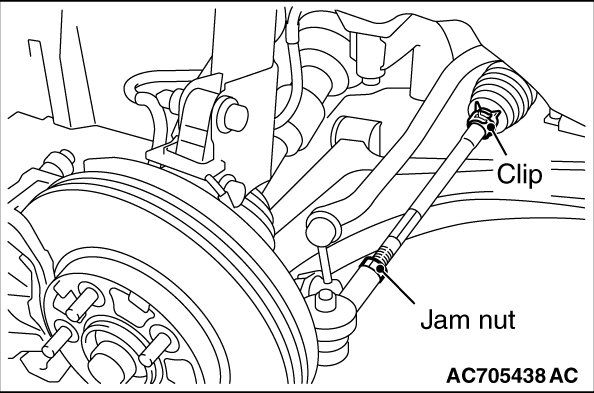
1.Loosen the jam nut with the tie-rod clip removed, and then perform the adjustment by turning the tie-rod left/right at the same degree in the opposite direction.
| note |
The toe moves to the outside by turning the tie-rod left to the forward direction, and right to the reverse direction.
|
2.After adjustment, check that the steering angle is within the standard range using the turning radius gauge. (Refer to GROUP 37 - On-vehicle Service  .) .)
|
|
|
Standard value:
-1°00’ ± 0°30’ (Left/right deviation within 0°30’)
|
|
|
Standard value:
4°25’ ± 0°30’ (Left/right deviation within 0°30’)
|
|
|
Kingpin inclination 13°50’ ± 1°30’
|
|
| note |
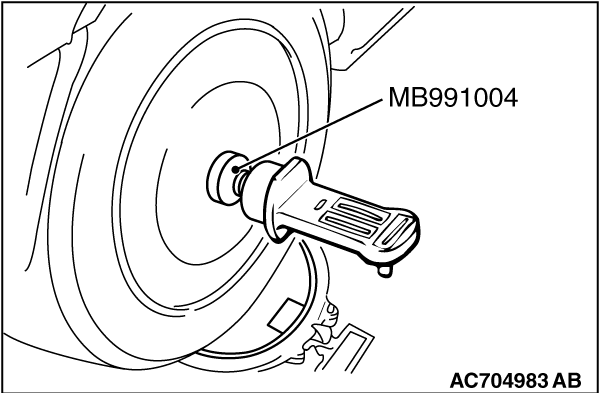
Tighten the wheel alignment gauge attachment (special tool: MB991004) to the specified torque, then perform measurement.
|
Tightening torque: 144 - 176 N·m (106 - 130 ft-lb)
|
![[Previous]](../../../buttons/fprev.png)
![[Next]](../../../buttons/fnext.png)
)
)