|
|
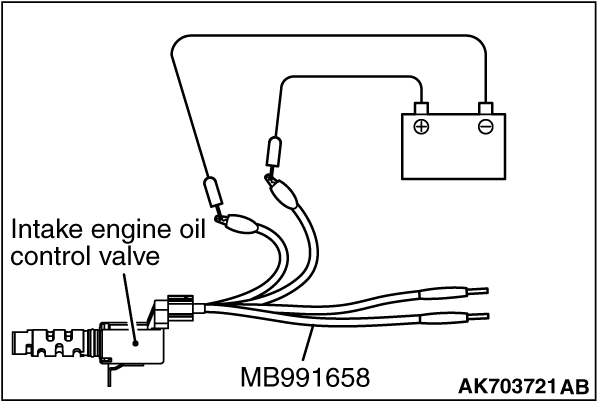
1.Disconnect the intake engine oil control valve connector.
|
|
2.
| caution |
To prevent the coil from burning, keep the duration of
the voltage application as short as possible.
|
Check that the operation sound of the intake engine oil control valve can be heard when
the positive battery voltage is supplied to the intake engine oil control valve. (Use the special
tool MB991658 to connect terminal No. 2 of the intake engine oil control valve connector to
the positive battery terminal and terminal No. 1 to the negative battery terminal.)
3.If the operation sound cannot be heard, replace the intake engine oil control valve.
|
|
|
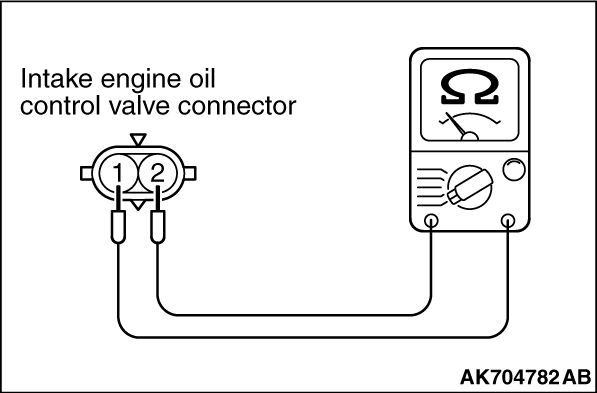
1.Disconnect the intake engine oil control valve connector.
|
|
2.Measure resistance between terminal No. 1 and terminal No. 2 of the connector at the intake
engine oil control valve side.
Standard value: 6.9 -
7.9 Ω
[at 20°C (68°F)]
3.If resistance is not within the standard value, replace the intake engine oil control valve.
|
|
|
1.Disconnect the exhaust engine oil control valve connector.
|

|
2.
| caution |
To prevent the coil from burning, keep the duration of
the voltage application as short as possible.
|
Check that the operation sound of the exhaust engine oil control valve can be heard when
the positive battery voltage is supplied to the exhaust engine oil control valve. (Use the special
tool MB991658 to connect terminal No. 2 of the exhaust engine oil control valve connector to
the positive battery terminal and terminal No. 1 to the negative battery terminal.)
3.If the operation sound cannot be heard, replace the exhaust engine oil control valve.
|
|
|
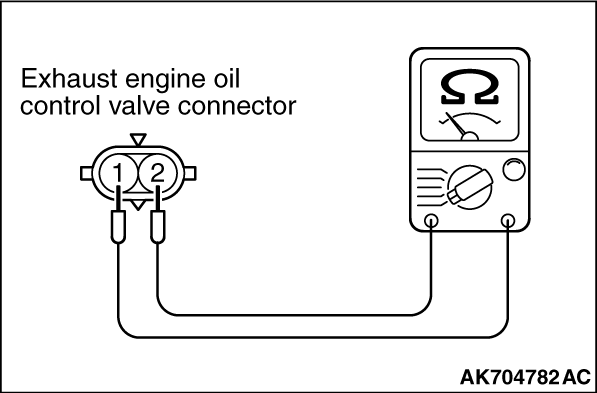
1.Disconnect the exhaust engine oil control valve connector.
|
|
2.Measure resistance between terminal No. 1 and terminal No. 2 of the connector at the exhaust
engine oil control valve side.
Standard value: 6.9 -
7.9 Ω
[at 20°C (68°F)]
3.If resistance is not within the standard value, replace the exhaust engine oil control valve.
|
![[Previous]](../../../buttons/fprev.png)
![[Next]](../../../buttons/fnext.png)
)
)
)
)